
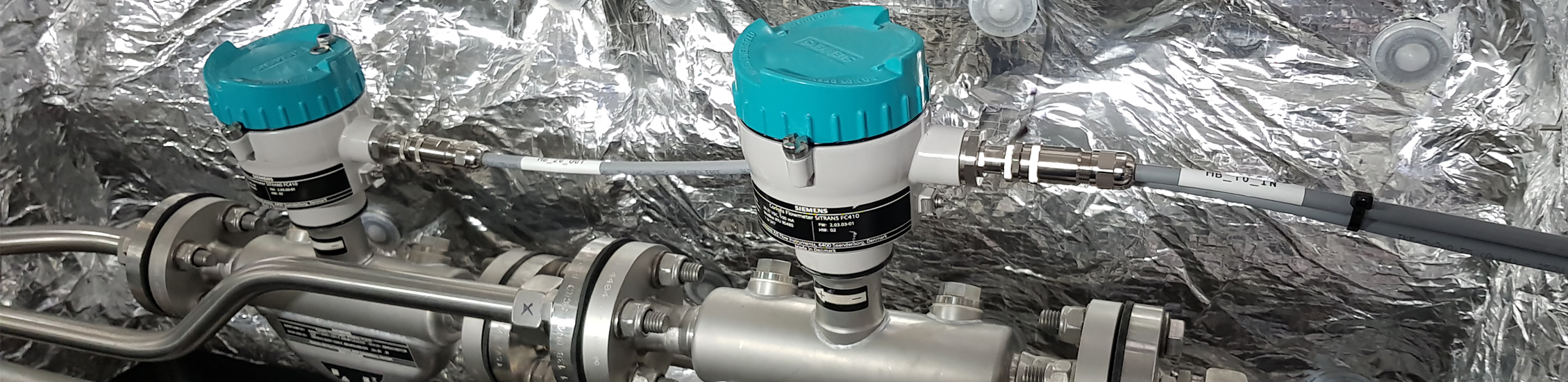
Fuel Measurement & Monitoring – Coriolis Meter
A key element of SMS’ performance monitoring is high frequency, high accuracy fuel consumption measurement by Coriolis Meter.
Coriolis Meter
Coriolis flow meters are a high performance, multi-parameter measurement technology for all types of fluid including marine fuels and are ideally suited to the rigours of operation on board ship. In recent years, Coriolis mass flow meters have become the fastest-growing metering technology due to their ability to directly measure mass flow with greater accuracy and reliability than traditional flow meters, whilst being independent of variations in fluid parameters such as pressure, temperature, viscosity, density and air entrainment. The port of Singapore has mandated the use of Coriolis mass flow metering (MFM) for bunker deliveries to ships since 2017 and Sustainable Maritime Solutions utilises Coriolis meters for high frequency monitoring of fuel consumption by ships’ engines.
Why Use Coriolis Meters?
- Simply put the largest expense associated with operating a ship is the cost of fuel, which fluctuates depending on fuel price and the efficiency of vessel operation.
- In the marine industry liquid fuel oils are traditionally delivered by volume and paid for by mass to reflect the quantity of energy the fuel will provide to power the ship. For years the standard way of measuring bunker deliveries has been by sounding of tanks, while volumetric flow meters have been used for noon reporting of daily fuel consumption. In both cases mass is calculated using density recorded on the bunker delivery note corrected for temperature.
- Charterers typically pay for fuel and so deliveries and daily consumption must be closely monitored and reported by the ship at noon. Coriolis meters are game changing in that they provide accurate and precise mass flow measurement at high frequency and high resolution. There is no need for any manual calculation using density and temperature, so removing the potential for errors.
- Coriolis meters provide quantity assurance by detecting and compensating for air entrained in the fuel, which may have been deliberately introduced to inflate the volume and so reduce the mass during delivery (the so-called “cappuccino effect”), or when naturally drawn into the system as a tank nears empty.
- Performance and efficiency monitoring and control of emissions are now key elements of modern ship operation. Coriolis meters can play an important role in environmental management. With real-time operating data available for ship staff and shoreside managers using today’s ship-shore satellite communications, fuel consumption can be monitored and optimized by changes in operating practice. Sources of wastage can be identified and rectified, so reducing costs and environmental impact.
- Coriolis meters are available in a wide variety of sizes from very large to very small and have a high turndown ratio making them ideally suited for services in the shipping industry ranging from large bunker deliveries to measuring fuel consumption of main and auxiliary engines of all sizes and fuel consumption rates.
- After initial factory calibration Coriolis meter performance is largely independent of fluid properties such as density, viscosity, and temperature. This makes the meters versatile for measuring various types of fuels from residual to distillate without the need for recalibration or adjustments when switching from one fuel to another.
- In addition to reporting fuel flow and total consumption, Coriolis meters report fuel density and temperature so compliance can be readily confirmed when changing over from residual fuel to distillate for operation in an Emission Control Area.
- Coriolis meters have no moving mechanical parts, require minimal maintenance and have a long lifespan. It is possible to have a local display in or close by the fuel room, however the meters used by SMS are connected to a Data Acquistion Unit in the Engine Control Room by a 4-conductor cable supplying 24VDC power and data communications. Mass flow rate, total fuel consumption, density, temperature and meter diagnostics are available continuously to view in the ECR. Data is logged and transmitted ship-shore for near real time viewing.
Operating Principle
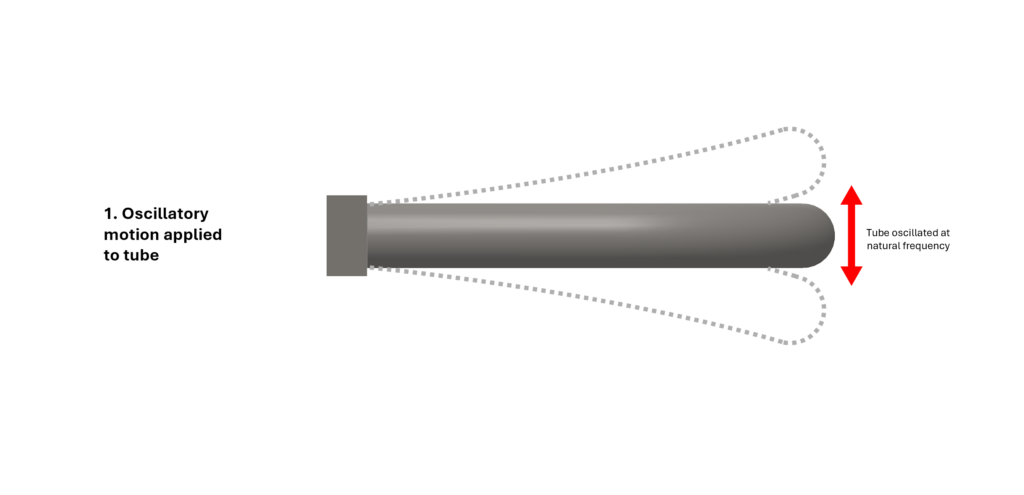
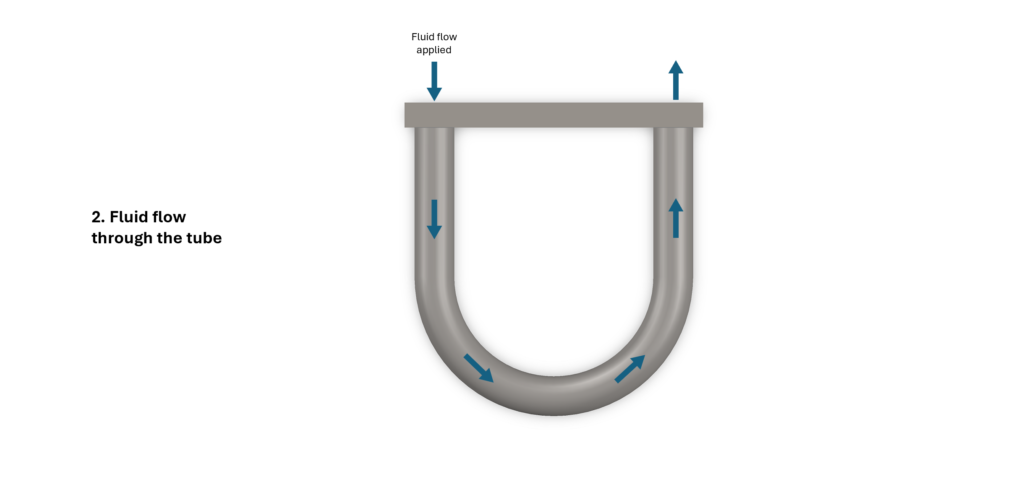
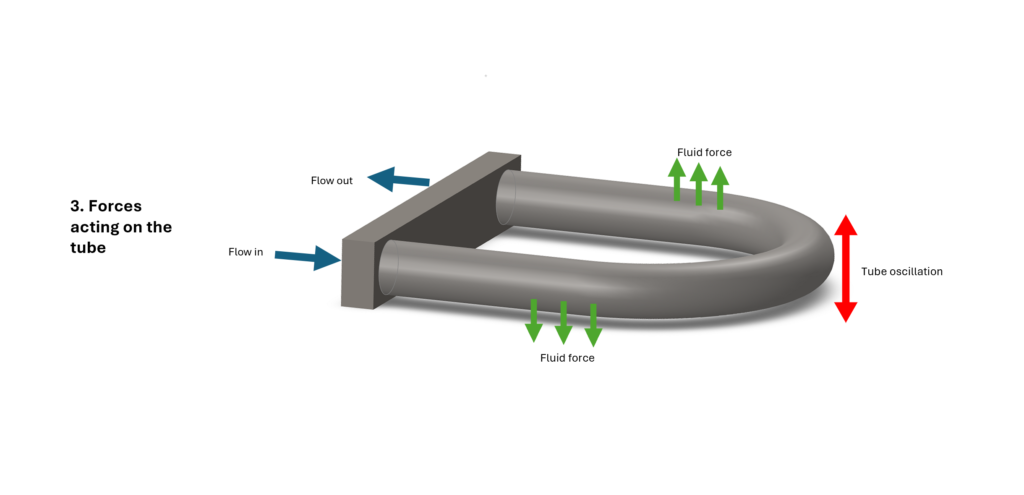
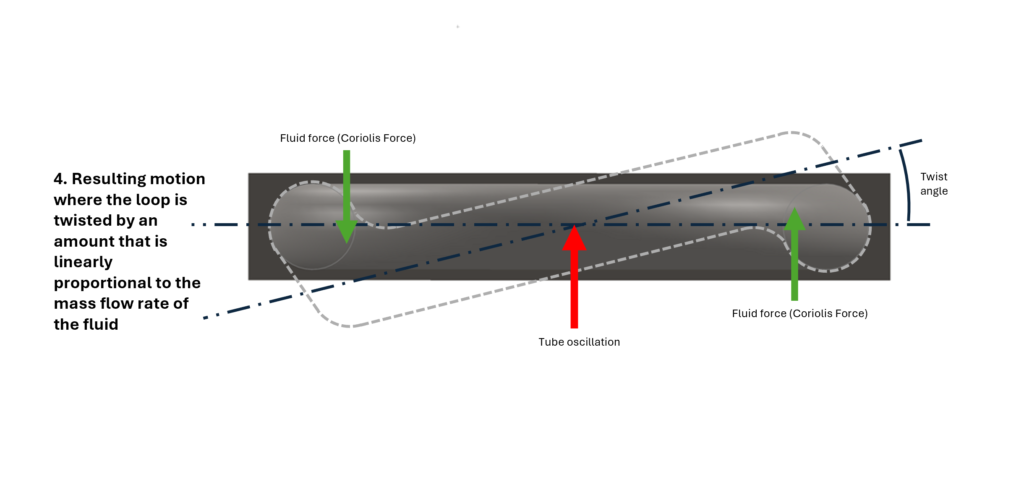
A Coriolis meter operates on the principle of the Coriolis force generated in a vibrating tube through which the fluid flows. This force is proportional to the mass flow rate of the fluid. The meter typically consists of one or two vibrating tubes with an inlet and an outlet, an electromagnetic drive to generate vibratory motion, two electromagnetic sensors to detect the phase difference between the vibrating arms of the tube, a feedback circuit to maintain vibrations at the functional frequency, and electronic means for measuring the phase difference between the signals received from the sensors shown in Figure 1.
As fluid flows through the meter, it accelerates on the inlet side and decelerates on the outlet side, generating a Coriolis force. This force causes a phase difference between the two vibrating arms of the tube, which is proportional to the mass flow rate, meaning the complete loop is twisted by an amount that is directly and linearly proportional to the mass flow rate of the fluid.
Meter Sizing
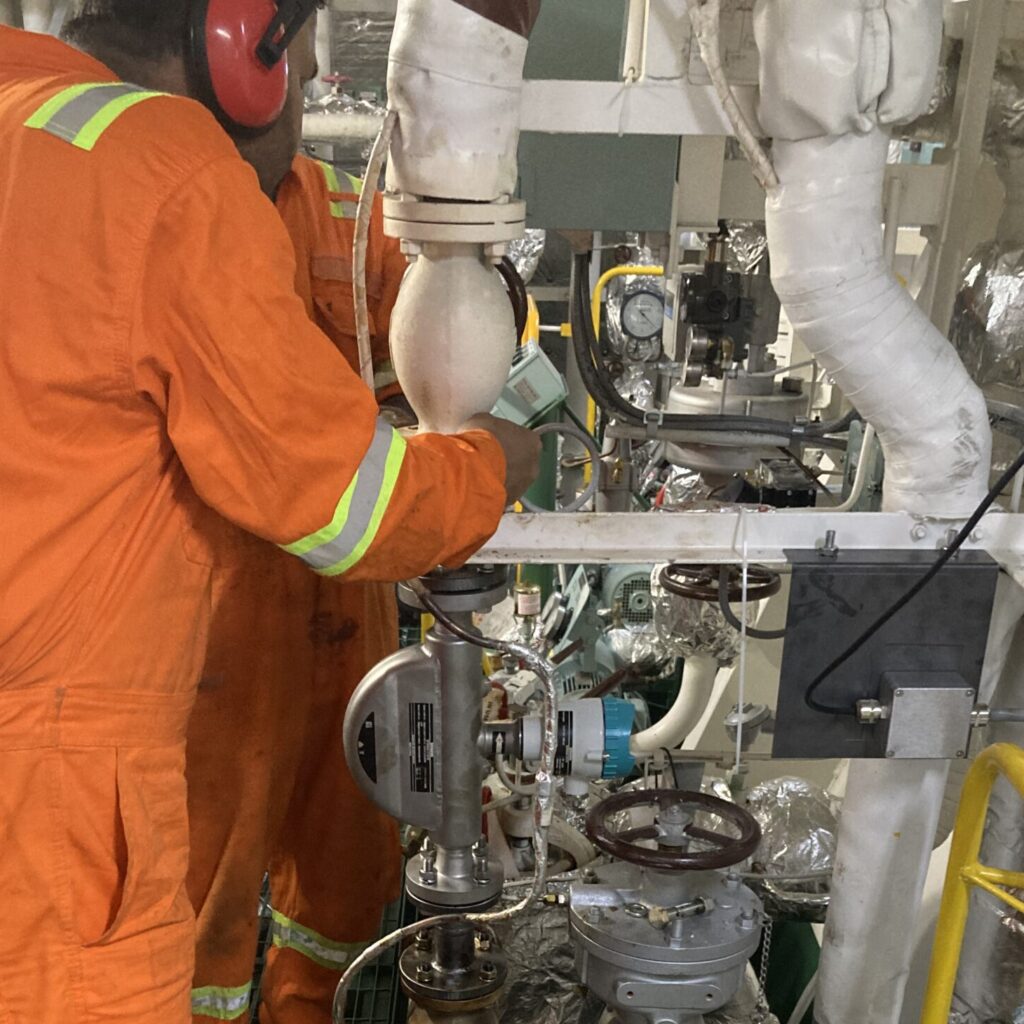
A practical comment made by ship staff at almost every installation is that the meter bore appears too small. Engineers on a typical deep-sea vessel with a 10MW slow speed 2 stroke main engine are familiar with perhaps 2-inch nominal size pipework and a large volumetric meter complete with bypass for fuel supply to the main engine. A suitable Coriolis meter for this application does not need to be this size and is likely be no bigger diameter than 25mm for optimal performance. Unlike the volumetric meter, the Coriolis meter consists of an open tube arrangement and has no internal moving parts, so the risk of blockage is virtually nil and although there is a pressure drop across the meter, it is always assessed with the meter manufacturer before installation, so that the size matches the consumption range of the engine.
SMS only uses marine type approved Coriolis meters from a leading OEM to ensure the meter is sized correctly so pressure drop is not an issue and measurement accuracy is optimized across the full range of fuel flows from the lowest during manoeuvring to the highest at maximum continuous load.
What About the Cost?
Mass is a fixed measure, it can neither be created nor destroyed, whereas volume is changeable under the influences of temperature, pressure and air entrainment. Given the price of marine fuel and the volumes involved even a small error in fuel measurement or calculation can translate to a significant cost. Seemingly small amounts of wastage through sub-optimal operating practice can quickly add-up and if not closely monitored by fuel consumption and ship speed, excessive fouling of the ship’s hull, especially after a period of time at anchor in the tropics, can be very costly unless cleaned promptly.
While the initial price of a Coriolis meter may be higher than a traditional volumetric meter, it is a sound investment particularly given the value of fuel flowing through it during a lifetime of service. Charterers, ship operators and staff on board can benefit from an accurate, reliable, high frequency and high-resolution device that provides quantity and compliance assurance and the means to identify and monitor operational efficiency improvements. In turn this can bring a financial and environmental win-win for all.